Read the daily reading and answer the following question: What does this passage reveal about the nature and character of God?
Follow the H.E.A.R. Bible Study Method (or engage with the Scriptures using another method of your choice).
Note: The F260 Reading is an additional Scripture Reading for those who want to read the foundational passages of Scripture throughout the year. SRC has been printing this plan from September 2018 through present day, so the current plan will conclude August 30, 2019.
Check out this link for information on some of the popular study bibles available today.
Right Now Media has a ton of resources on how to study the Bible. If you do not already have access to Right Now Media, go to southridgechurch.net, click on “Connect” and then scroll down to “Grow Thru Bible Based Learning.” Once there, you can create a Right Now Media (RNM) account, providing you free access to hundreds of Bible Studies!
Read the daily reading and answer the Daily Questions.
Follow the H.E.A.R. Bible Study Method (or engage with the Scriptures using another method of your choice).
Note: The F260 Reading is an additional Scripture Reading for those who want to read the foundational passages of Scripture throughout the year. SRC has been printing this plan from September 2018 through present day, so the current plan will conclude August 30, 2019.
Check out this link for information on some of the popular study bibles available today.
Right Now Media has a ton of resources on how to study the Bible. If you do not already have access to Right Now Media, go to southridgechurch.net, click on “Connect” and then scroll down to “Grow Thru Bible Based Learning.” Once there, you can create a Right Now Media (RNM) account, providing you free access to hundreds of Bible Studies!
Read the daily reading and answer the Daily Questions.
Follow the H.E.A.R. Bible Study Method (or engage with the Scriptures using another method of your choice).
Note: The F260 Reading is an additional Scripture Reading for those who want to read the foundational passages of Scripture throughout the year. SRC has been printing this plan from September 2018 through present day, so the current plan will conclude August 30, 2019.
Check out this link for information on some of the popular study bibles available today.
Right Now Media has a ton of resources on how to study the Bible. If you do not already have access to Right Now Media, go to southridgechurch.net, click on “Connect” and then scroll down to “Grow Thru Bible Based Learning.” Once there, you can create a Right Now Media (RNM) account, providing you free access to hundreds of Bible Studies!
Read the daily reading and answer the Daily Questions.
Follow the H.E.A.R. Bible Study Method (or engage with the Scriptures using another method of your choice).
Note: The F260 Reading is an additional Scripture Reading for those who want to read the foundational passages of Scripture throughout the year. SRC has been printing this plan from September 2018 through present day, so the current plan will conclude August 30, 2019.
Check out this link for information on some of the popular study bibles available today.
Right Now Media has a ton of resources on how to study the Bible. If you do not already have access to Right Now Media, go to southridgechurch.net, click on “Connect” and then scroll down to “Grow Thru Bible Based Learning.” Once there, you can create a Right Now Media (RNM) account, providing you free access to hundreds of Bible Studies!
Read the daily reading and answer the Daily Questions.
Follow the H.E.A.R. Bible Study Method (or engage with the Scriptures using another method of your choice).
Note: The F260 Reading is an additional Scripture Reading for those who want to read the foundational passages of Scripture throughout the year. SRC has been printing this plan from September 2018 through present day, so the current plan will conclude August 30, 2019.
Check out this link for information on some of the popular study bibles available today.
Right Now Media has a ton of resources on how to study the Bible. If you do not already have access to Right Now Media, go to southridgechurch.net, click on “Connect” and then scroll down to “Grow Thru Bible Based Learning.” Once there, you can create a Right Now Media (RNM) account, providing you free access to hundreds of Bible Studies!
Read the daily reading and answer the Daily Questions.
Follow the H.E.A.R. Bible Study Method (or engage with the Scriptures using another method of your choice).
Note: The F260 Reading is an additional Scripture Reading for those who want to read the foundational passages of Scripture throughout the year. SRC has been printing this plan from September 2018 through present day, so the current plan will conclude August 30, 2019.
Check out this link for information on some of the popular study bibles available today.
Right Now Media has a ton of resources on how to study the Bible. If you do not already have access to Right Now Media, go to southridgechurch.net, click on “Connect” and then scroll down to “Grow Thru Bible Based Learning.” Once there, you can create a Right Now Media (RNM) account, providing you free access to hundreds of Bible Studies!
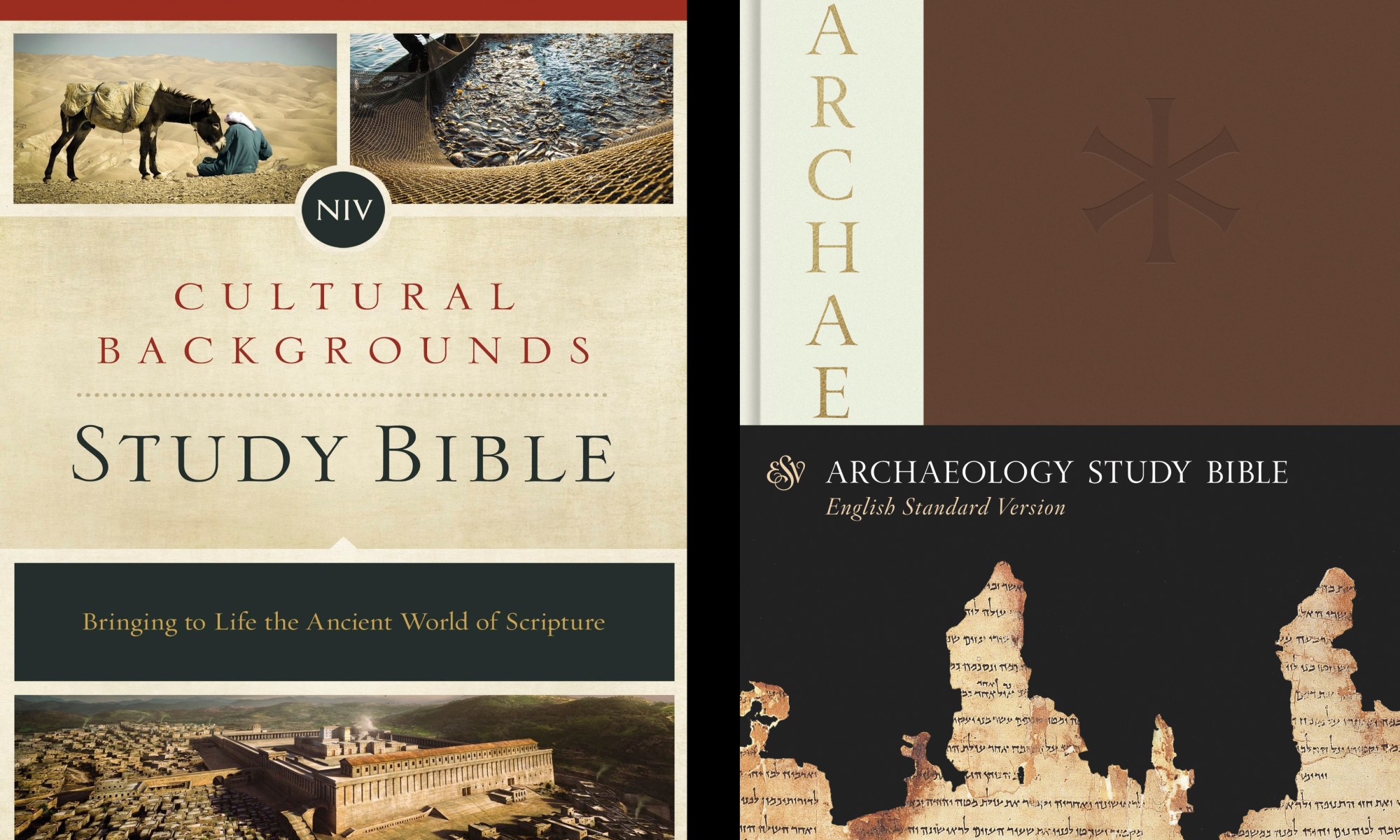
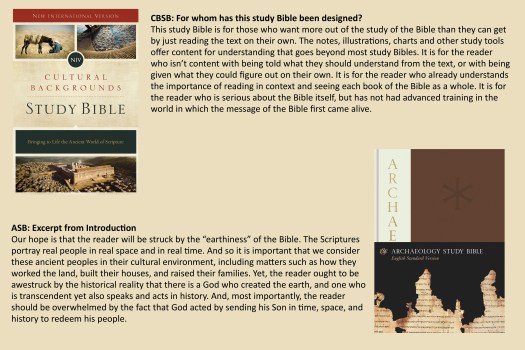
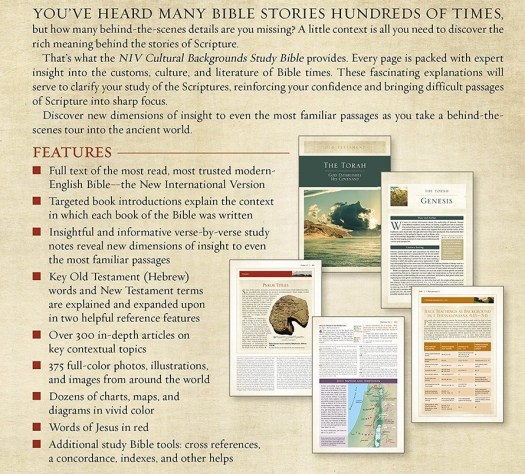
A little while ago, I took the opportunity to post about some of the popular Study Bibles available today. In that post I noted that my current go-to Study Bible is the NIV Cultural Backgrounds Study Bible. However, with the recent release of the ESV Archaeology Study Bible, I believe there are some out there who are trying to determine which one would be best for their needs, or questioning whether or not there’s a place for both in their library. As such, I wanted to do a offer thorough comparison of the two. (This is not necessarily a review of each Study Bible, but merely a comparison between the kinds of study notes within each one.)
Cultural Backgrounds Study Bible vs. ESV Archaeology Study Bible
Who is the target audience for these Study Bibles?
I believe the target audience for each of these Study Bibles would be either a college student who is currently studying ancient history and/or archaeology or a college graduate who has a personal interest in ancient history.
What’s the focus of each Study Bible?
Additional Features:
NIV Cultural Backgrounds Study BibleESV Archaeology Study Bible
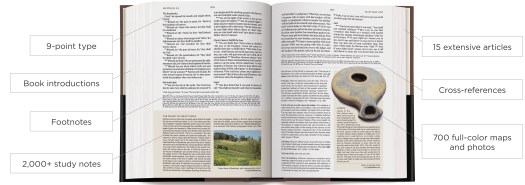
Personal Thoughts on the Features:There’s no use getting caught up in the number of images, graphics, charts, maps, or even the number of study notes provided. Both are excellent. If you’re at all interested in promotional videos, the video below was released by Zondervan and offers some additional insight into the features, purpose, and goals of the CBSB. (The ESV Archaeology Study Bible doesn’t have any videos released by the publisher.)
OK, enough with the basics! I want to see some differences within the Study Notes!
As noted above, I’ve been reading exclusively from the Cultural Backgrounds Study Bible for about 4 months, and throughout that time I’ve highlighted a few passages and commentary notes that stuck out to me. With the recent release of the ESV Archaeology Study Bible, I’ve taken the opportunity to compare/contrast these two Study Bibles on some of these passages.
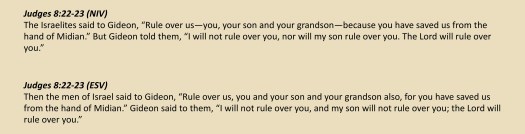
TRANSLATION COMPARISON: JUDGES 8:22-23
This is an interesting passage, as it highlights a situation that occurred prior to the nation of Israel becoming a monarchy. The commentary notes from the CBSB add some context to this passage that really helps the reader to see this passage differently.
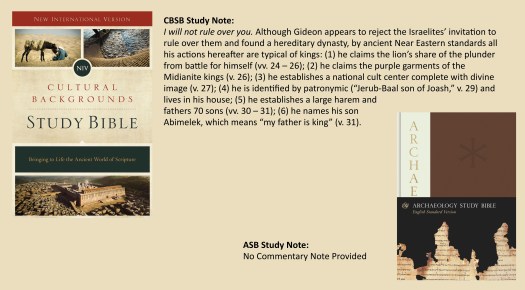
STUDY NOTE COMPARISON: JUDGES 8:22-23
Personal Thoughts: Obviously, the passage in question has little to do with archaeology. As such, the Cultural Backgrounds Study Bible offers much more insight into the context of this passage. While the Biblical text notes that Gideon decided to not rule over the people, the commentary notes that he still took advantage of the situation, accepting the bulk of the plunder and even naming his son in such a way that displays his ‘royalty’.
. . . . .
TRANSLATION COMPARISON: JOSHUA 10:12-13
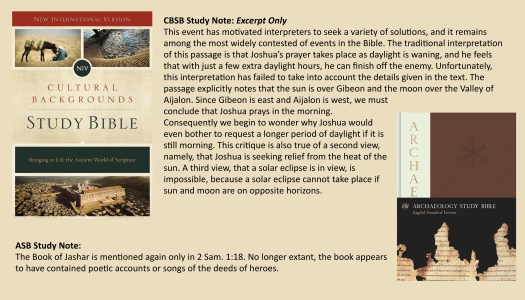
STUDY NOTE COMPARISON: JOSHUA 10:12-13
Personal Thoughts:Once again, the Cultural Backgrounds Study Bible offers tremendous detail on the passage, weighing various options for how the passage could have been read or understood by the people in Ancient Israel. The ESV Archaeology Study Bible focuses only on the mention of the Book of Jahar. The CBSB, however, also mentions the book of Jahar in 2 Samuel 1:18.
CBSB Study Note: 2 Samuel 1:18 — Book of Jashar. Appears to have been a book of early Israelite poetry, now lost. In addition to the present passage, it is mentioned in Jos 10:12 – 13 in the account of Joshua’s exceptional day in defense of the Gibeonites. The name is generally assumed to derive from the Hebrew word meaning “upright, just, righteous,” and the like, suggesting that the Book of Jashar may have celebrated the exploits of heroic individuals in Israel or of the Israelites as a whole, as the Lord’s “upright” people. Alternatively, the name may reflect the Hebrew word for “song,” yielding simply the “Book of Song.”
. . . . .
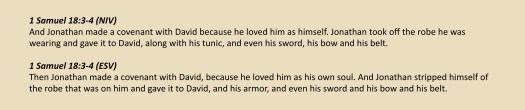
TRANSLATION COMPARISON: 1 SAMUEL 18:3-4
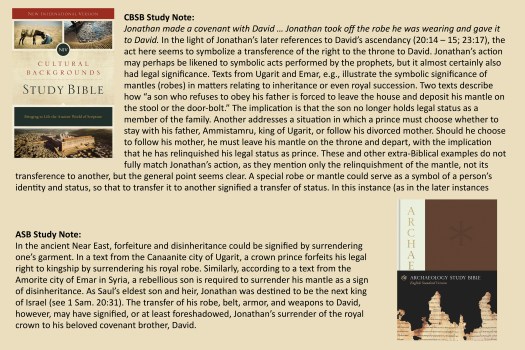
STUDY NOTE COMPARISON: 1 SAMUEL 18:3-4
Personal Thoughts: Both Study Bibles offer excellent insight into this passage.
. . . . .
STUDY NOTE COMPARISON: THE JAMES OSSUARY
This is not a study note on a particular passage, but is instead an article highlighting the (likely) discovery of the James Ossuary.
Personal Thoughts: I was a bit surprised that the CBSB didn’t have any mention of the James ossuary. (An ossuary is basically an ancient coffin, sometimes referred to as a ‘bone box.’) Not only is the James ossuary a remarkable archeological discovery, but it aids scholars in better understanding the culture of the time period of Jesus and his family. Anyway, the Archaeology Study Bible article is well written, providing many of the details about this fascinating discovery.
. . . . .
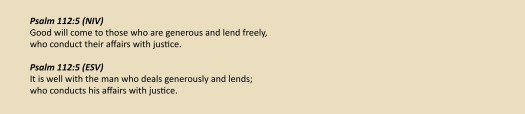
TRANSLATION COMPARISON: PSALM 112:5
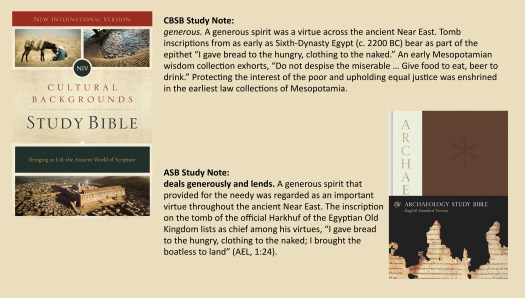
STUDY NOTE COMPARISON: PSALM 112:5
Personal Thoughts: I included this note as both quote from the same source, showing some similarities between the two bibles.
. . . . .
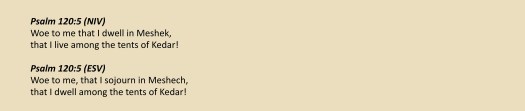
TRANSLATION COMPARISON: PSALM 120:5
STUDY NOTE COMPARISON: PSALM 120:5
Personal Thoughts: I provided this passage because it’s one that most readers will quickly read through the Psalm and move on. However, both Study Bibles offer detailed historical references about Mesheck and Kedar. It’s a good example as to what kind of notes you’re going to discover in either Study Bible. If you find this kind of information fascinating, then these are both excellent resources.
. . . . .
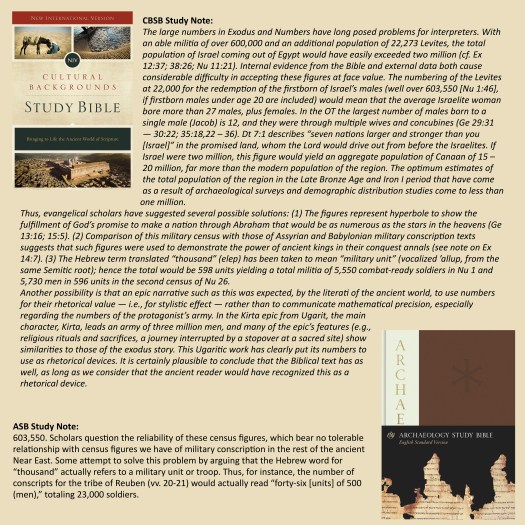
TRANSLATION COMPARISON: NUMBERS 1:46
STUDY NOTE COMPARISON: NUMBERS 1:46
Personal Thoughts: Clearly, the Cultural Backgrounds Study Bible offers more detail into this passage. However, both study bibles note that scholars question the reliability and/or translation of the number provided here.
. . . . .
STUDY NOTE COMPARISON: JESUS’ BAPTISM (JOHN 1:28 & MATTHEW 3:13-16)
Personal Thoughts: Each Study Bible takes a different approach on these passages, with the CBSB focusing on the different people groups and events at the time of Jesus’ baptism, while the ASB focuses on the possible location.
. . . . .
ADDITIONAL RANDOM COMMENTARY NOTES: CULTURAL BACKGROUNDS STUDY BIBLE
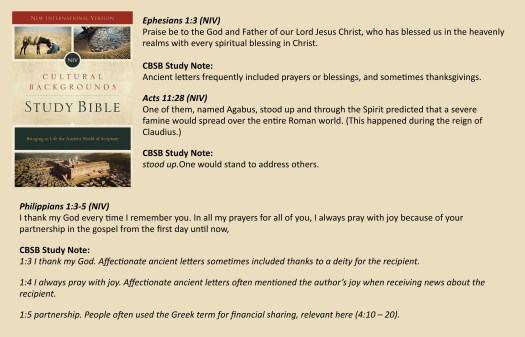
Personal Thoughts: Commentary notes such as these are unnecessary. They clutter the page and offer little value to the text. While I’ve only been in the CBSB for about 4 months, I have found commentary notes such as these more often in the New Testament than the Old Testament. I’m just puzzled as to why some of them are included at all.
ADDITIONAL RANDOM COMMENTARY NOTES: ARCHAEOLOGY STUDY BIBLE
Personal Thoughts: From my limited reading, I’ve found that the more simplistic notes within the New Testament of the Archaeology Study Bible offer more insight/value into the text.
. . . . .
Conclusion: As you can tell, both of these Study Bibles are excellent in helping the reader understand the background of text, each providing cultural and archaeological insight into the passages.
If I was forced to choose just one of these two resources, I would likely choose the Cultural Backgrounds Study Bible because I prefer the more modern reading NIV text compared to the ESV. Additionally, from my limited reading of the two and comparing and contrasting some of the commentary notes, the historical information provided in the NIV CBSB sometimes outweighs that which is available in the ESV ASB.
Is there a reason to own both? If you’re really into ancient history, then sure. I own a hard copy of the CBSB and digital copies (through Olive Tree) of both. The great thing about the digital copy is you can read whatever translation you most prefer with the commentary notes side by side. I was able to get both for about $20 each through different sales that Olive Tree offered.
If you would like to see even more of what these Study Bibles has to offer, here are some PDF documents provided by the publishers.
In case you weren’t aware, there are a lot of Study Bibles on the market. Like, a lot a lot. While the Study Bible market was pretty stagnant 30-40 years ago, an increase in scholarship and technology has made the Bible easier to read and study than ever before.
Why use a Study Bible?
The 66 books of the Bible were written thousands of years ago to people in cultures that are very different from the Western Culture in which we live today. As such, a good Study Bible will help you, the reader, better understand the purpose and meaning of the Biblical text.
Which Study Bible is ‘best’?
This is a ridiculously challenging question to answer. I often respond by saying, “The ‘best’ Bible is the one you’re reading.” But most people who are looking to study God’s Word are looking for more specifics. They’re looking to invest some money into a Bible that they’ll likely be reading for years and years. So which one is best… for you?
Well, every Study Bible has different features, different scholars, different goals, and in the end, each one provides a different study experience for the reader. Below is a simple breakdown of several options available today. Which one you may choose to read and study with is up to you, but I’ve done my best to offer some recommendations depending on what you think may be most beneficial for you.
Please note that the following list and information is provided in no specific order. Also note that the majority of these Study Bibles are large and heavy. As such, information on digital versions are available at the end of this post.
NLT or NIV Life Application Study Bible, Third Edition (Translation: New Living Translation or New International Version)
Who is the NLT (or NIV) Life Application Study Bible for?
The Life Application Study Bible (LASB) is the best selling Study Bible of all time, and for good reason. Personally, I would wholeheartedly recommend the The NLT (or NIV) Life Application Study Bible as somebody’s first Study Bible. Even if it’s not your first Study Bible, it’s worth having one of these on your shelf.
From a marketing perspective, the publisher notes that the LASB is the most complete Bible ever compiled. Even though this is nothing more than marketing hype, there’s a lot to love about the NLT (or NIV) LASB.
Picture of digital edition.
All in all, the LASB is an excellent all around Study Bible that does a great job of explaining how to apply each passage by answering the question, “So what?” For example, you may read the Ten Commandments in Exodus 20 and ask, “So what?” But the LASB provides an in-depth commentary note, stating:
“Why were the Ten Commandments necessary for God’s new nation? At the foot of Mount Sinai, God showed his people the true function and beauty of His laws. The commandments were designed to lead Israel to a life of practical holiness. In them, people could see the nature of God and his plan for how they should live. The commands and guidelines were intended to direct the community to meet the needs of each individual in a loving and responsible manner. By Jesus’ time, however, most people had come to look at the law the wrong way. They saw it as a means to prosperity in both this world and the next. And they thought that obeying every law was the way to earn God’s protection from foreign invasion and natural disaster. They failed to see that keeping the law should be the means to fulfill God’s ultimate law of love.”
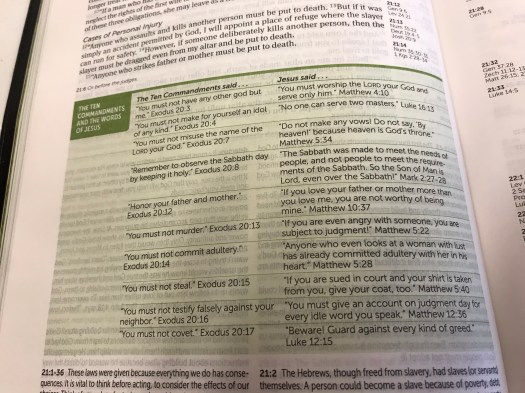
Picture of print edition showing chart on the Ten Commandments vs. quotes from Jesus. Some bleed through of the thin pages is noticeable, but not a distraction while reading.
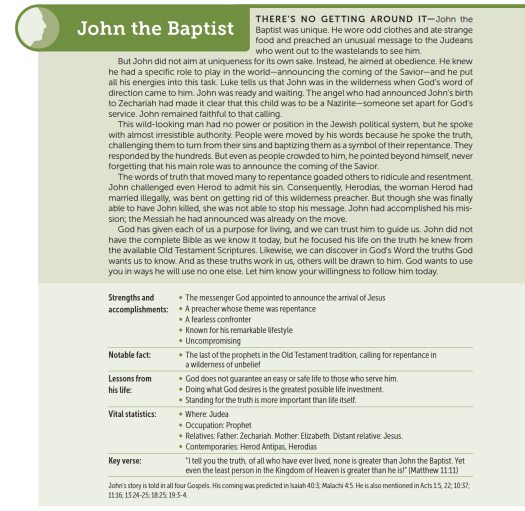
Even though the very first Life Application Study Bible was released 30 years ago, a tremendously updated Third Edition was released in October 2019. This new edition has 30-40% new material compared to the previous editions. While it may not be as colorful as the NIV Zondervan Study Bible mentioned below, it contains wonderful commentary, profiles on about 150 people throughout the Bible, and hundreds of charts and maps.
Here is a link to more of my thoughts on the most recent release of the NLT Life Application Study Bible.
And for those who may be interested, here is a sampler that offers additional insights into the NLT LASB. You can also click here to see some videos and additional graphics from this release.
NIV Zondervan Study Bible (Translation: New International Version)
Who is the NIV Zondervan Study Bible for?
Released in 2015, the NIVZSB is an excellent all around Study Bible that brings additional insight and clarity to the text. I would place it as another excellent option for somebody’s first Study Bible. The commentary notes are a little lengthier than the NLT Study Bible, and as such it’s quite heavy. Nevertheless, it’s also gorgeous, with a colored font to make headings and commentary notes easier to find, as well as charts and images that really pop.
A few years ago I did a personal study of the Psalms, and the NIVZSB became my go-to resource when looking for a brief summary of the purpose or meaning of each Psalm. All in all, it’s another excellent Study Bible.
If you want to have a closer look, here’s a sampler that offers additional insights into the NIVZSB.
NLT Study Bible (Translation: New Living Translation)
Who is the NLT Study Bible for? The NLT Study Bible is generally a perfect fit for somebody’s first Study Bible. The translation is easy to read and understand, the commentary notes are written in a way that bring clarity to the text, and the book introductions help bring some clarity to who wrote each book and it’s purpose. For those who want to take the extra step of studying some key Greek/Hebrew words, there’s a way to do that as well. The NLT Study Bible may not be the most colorful one available today, but it’s often the one I recommend to most people seeking their first Study Bible.
If you want to have a closer look here’s a sampler that offers additional insights into the NLT Study Bible.
ESV Study Bible (Translation: English Standard Version)
Who is the ESV Study Bible for?
Personally, I would only recommend the ESV Study Bible to a college graduate and/or somebody who wants to go deeper into the biblical text than the NLTSB or NIVZSB will go. Honestly, that’s pretty high praise for the ESVSB, because the NLTSB and NIVZSB are quite in depth!
But when it comes to the ESV translation, I confess I’m not a fan. While the ESV text does an excellent job of providing a more direct translation of the Greek/Hebrew text than the NLT or NIV, it also has the possibility of making it more challenging to read as the verbiage may come across a bit archaic.
Still, the ESV Study Bible footnotes are regarded as some of the best of the best out there. And on passages where a number of different scholarly views are held, the ESV will often list the 3-4 different views, without telling you which is the ‘right’ one. Finally, the book introductions are probably some of the best that are offered in a Study Bible. It’s likely the heaviest of all the Study Bibles mentioned here, because it’s got A LOT of information provided.
NIV Cultural Backgrounds Study Bible (Translation: New International Version)
Who is the NIV Cultural Backgrounds Study Bible for?
The NIV Cultural Backgrounds Study Bible is perfect for the college graduate or History Education major who has a real interest in ancient cultures. While I wouldn’t recommend it to just anybody, it is currently my go-to Study Bible each and every morning.
To be clear, the NIVCBSB generally steers clear of theology and notes that answer the question, “What does this text mean?” What it does really well, however, is answer the question, “What did this text mean to the people who first read it?” It’s an important distinction, as we may not often think about the Code of Hammurapi and other cultural laws known to the people in ancient Israel. Nor may we consider the cultural significance of Jonathan giving his tunic to David in 1 Samuel 18. But for those fascinated with ancient culture and/or archaeology and don’t mind reading commentary written in a scholarly manner, the NIVCBSB is excellent.
If you’re interested, here’s a sampler of the Cultural Backgrounds Study Bible that includes the full books of Genesis and Matthew. You’ll likely be able to decide very quickly if the Cultural Backgrounds Study Bible is for you or not.
ESV Archaeology Study Bible (Translation: English Standard Version)
Who is the ESV Archaeology Study Bible for?
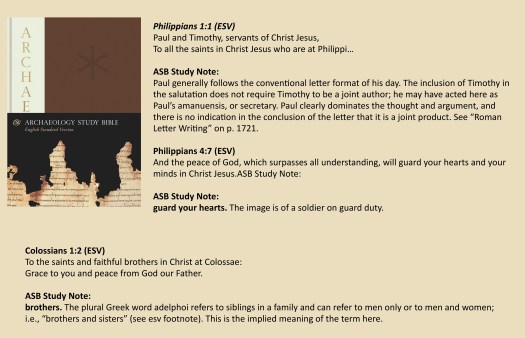
The ESVASB was just released in 2018, and was published by a different publisher than the Cultural Backgrounds Study Bible, with different scholars contributing. In other words, the ESV Archaeology Study Bible has a slightly different focus than the Cultural Backgrounds Study Bible. That said, I would still only recommend it to those with a high interest in ancient cultures and/or archaeology.
At this time, I don’t have much to say about it as I’ve only read a few excerpts. That said, the few that I did compare with the Cultural Backgrounds Study Bible were similar, but the ESVASB noted some more details on archaeological discoveries that the CBSB didn’t cover. And in other places, the CBSB had more details on the ancient cultures that the ESVASB didn’t cover.
If you’re interested, here’s a sampler of the ESV Archaeology Study Bible that includes the full book of Philippians.
CSB Study Bible (Translation: Christian Standard Bible)
Who is the CSB Study Bible for?
The CSBSB is an updated version of what was formerly known as the Holman Christian Standard Bible. It has a number of similarities to the NLTSB, NIVZSB, and ESVSB noted above. Honestly, the biggest difference between these four are the translations used. For those unacquainted with the CSB, it reads very much like the NIV.
Admittedly, one thing the translators of the CSB did well is with the translation of John 3:16, “For God loved the world in this way: He gave His one and only Son…” The phrase in this way is the best translation of the Greek.
The one thing that most sets apart the CSB Study Bible from some of the others already mentioned is that Greek/Hebrew Word Studies are available throughout the commentary, and the editors really made them stand out. These word studies bring additional clarity to the text without the need to flip to the back of the Study Bible.
If you want to have a closer look, here’s a sampler that offers additional insights into the CSBSB.
. . . . .
These Bibles are HUGE! Isn’t there a better way?
I’m not going to lie, I read kindle books on my iPad a lot. A lot a lot. Like, almost every day. But over the past five years I’ve slowly moved from reading God’s Word digitally to reading it on paper. There’s just something about reading/studying the Bible distraction free. And distractions come a bit too easily to me when I’m staring at a screen. But I digress…
Almost all of the Study Bibles mentioned above are available digitally. What’s the best way to read them?
AVOID Study Bibles on the Kindle app. They’re generally hard to navigate, and will likely cause more frustration than it’s worth.
USE an app or software program designed for Bible Study. Olive Tree and Logos are both excellent.
Regarding Olive Tree: Study Bibles often go on sale, and their customer support may be willing to provide it a lower cost. For example, the NIV Cultural Backgrounds Study Bible has it’s own app (designed by Olive Tree) for $19.99, but the same Study Bible provided as an in-app-purchase runs $29.99. A simple email to customer support will likely land you the IAP for the same price of $19.99, and you can run it all within the same Olive Tree App with additional Study Resources. Olive Tree is also available on Mac/PC, and your resources, highlights, notes will sync between devices.
Regarding Logos: Logos is a premier Bible Study software, with a ridiculous number of resources. If you really want to dive into the Biblical text and have several commentaries, bible dictionaries, word studies, and a ton of additional information, it’s the go-to software program. That said, you get what you pay for, and you’ll be paying a lot for a package on Logos. Still, the software itself is a free download for Mac/PC and the app is free as well. Those who download the app can also receive a free copy of the Faithlife Study Bible, which is yet another excellent resource. Finally, individual books / Study Bibles can be purchased directly from Logos, so buying a large package isn’t necessary. And like Olive Tree, all resources, highlights, and notes will sync between devices.
The main benefit of any software or app is that you can read your preferred translation right next to your preferred Study Bible. So if you want to read the New Living Translation next to the ESV Study Bible notes, you can do that.
What do I use?
Short answer: both
Long answer: I use Olive Tree for basic Bible Reading / Study Bible use (excellent in a Small Group setting or personal reading) and I use Logos for deeper study.
. . . . .
Have a question about one of these Study Bibles or perhaps another one not mentioned here? Feel free to leave a comment I’ll do my best to answer!








 Study Bible, and as such it’s quite heavy. Nevertheless, it’s also gorgeous, with a colored font to make headings and commentary notes easier to find, as well as charts and images that really pop.
 Who is the NLT Study Bible for? The NLT Study Bible is generally a perfect fit for somebody’s first Study Bible. The translation is easy to read and understand, the commentary notes are written in a way that bring clarity to the text, and the book introductions help bring some clarity to who wrote each book and it’s purpose. For those who want to take the extra step of studying some key Greek/Hebrew words, there’s a way to do that as well. The NLT Study Bible may not be the most colorful one available today, but it’s often the one I recommend to most people seeking their first Study Bible.
 Who is the ESV Study Bible for?
 Who is the ESV Archaeology Study Bible for?

 south ridge blog