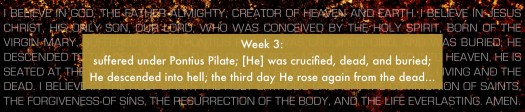
The Apostles’ Creed: Under Pontius Pilate He was Crucified

03 Week 3 Banner

WEEK 3, DAY 1: Under Pontius Pilate He was Crucified

A careful reading of the Apostles’ Creed will show that the only names mentioned include God (God the Father, Jesus Christ, the Holy Spirit) and two others, Mary, the mother of Jesus, and Pontius Pilate. 

Pilate was a political governor whose job was to oversee the the area in and around Jerusalem. As such, nobody could be sentenced to death without the governor’s approval. The Jewish leaders could find lawbreakers to be guilty, but they could only offer punishment to a certain extent. Serious punishment had to be agreed-upon by the proper authorities. 

For his part, Pontius Pilate was not Jewish, nor did he know much about Jesus. In fact, there were three separate occasions in which Pilate declared he could find no fault in Jesus, and certainly nothing that would make Him punishable by death. 

But the Jewish leaders refused to back down and continued to press their case. Not only that, they declared allegiance to the Roman Empire and warned Pilate they would inform the emperor that he refused to eliminate a rebel against the empire. Pilate knew what was right, but made a decision based on fear. 

READING & JOURNALING:

     LUKE 23:1-25

Read through today’s reading carefully. What sticks out to you most from today’s reading?

Write about a time when you (1) Made a decision based on fear, like Pilate, (2) Mocked somebody or something you didn’t fully understand, like Herod, and (3) Experienced suffering at the hands of others, like Jesus? 

PRAYER:

Today, write out your own prayer to God based on the your response to the above question. 


F260 READING: (A Scripture Reading Plan for Busy Believers)

The F260 is a Scripture Reading Plan designed to read through the foundational passages of the Bible through a year (September 2019 – August 2020). It is a separate reading from the daily devotional but is included for those who would like to engage with the Scriptures on a deeper level throughout the year.

Read: Psalm 119:127-176, Psalm 137

Journal: Write it out. Following the pattern from 7 Arrows Page (click here) what did you learn from today’s reading?


Note: Are you looking for a Study Bible to help you engage with the Scriptures at a deeper level? If so, click here for some recommendations.


The Apostles’ Creed: Week 2 Review

02 Week 2 Banner

WEEK 2, DAY 5: Review

What was your biggest takeaway from this week’s teaching — “I believe in Jesus Christ, His only begotten Son, our Lord; who was conceived by the Holy Spirit, born of the virgin Mary?”


F260 READING: (A Scripture Reading Plan for Busy Believers)

The F260 is a Scripture Reading Plan designed to read through the foundational passages of the Bible through a year (September 2019 – August 2020). It is a separate reading from the daily devotional but is included for those who would like to engage with the Scriptures on a deeper level throughout the year.

Read: Psalm 119:49-128


Journal: Write it out. Following the pattern from 7 Arrows Page (click here) what did you learn from today’s reading?


Note: Are you looking for a Study Bible to help you engage with the Scriptures at a deeper level? If so, click here for some recommendations.


The Apostles’ Creed: Born of the Virgin Mary

02 Week 2 Banner

WEEK 2, DAY 4: Born of the Virgin Mary

The story of Jesus’ conception by the power of the Holy Spirit and the virgin birth is a foundational teaching of the Christian faith. While there aren’t any scripture passages that speak of praying to Mary, it’s clear that Mary had a significant role in the birth and upbringing of Jesus. In fact, Jesus wanted to ensure his mother was well cared for after his death (see John 19:26). So, who was Mary? And what lessons do we learn from her life? 

According to notes in the Life Application Study Bible’s we can note the following strengths and accomplishments of her life:

  • The mother of Jesus, the Messiah
  • Willing to be available to God
  • Knew and applied Old Testament scriptures. 

Additionally, we learn the following lessons from her life:

  • God’s servants are often ordinary people who make themselves available to Him. 
  • A person’s character is revealed by his or her response to the unexpected. 

READING & JOURNALING:

     LUKE 2:1-52

What do you think about the note from the Life Application Study Bible that, “God’s servants are often ordinary people who make themselves available to Him?” 

Be honest, how much do you make yourself available to God? What would it look like to make yourself fully available to Him today?  

PRAYER:

Heavenly Father, while I like to think I regularly make myself available to You, I know there are times every single day when I am living for myself and my own desires. Your Word affirms that Your servants are often ordinary people who make themselves available to You. May I make myself wholly available today. In Jesus’ name. Amen. 


F260 READING: (A Scripture Reading Plan for Busy Believers)

The F260 is a Scripture Reading Plan designed to read through the foundational passages of the Bible through a year (September 2019 – August 2020). It is a separate reading from the daily devotional but is included for those who would like to engage with the Scriptures on a deeper level throughout the year.

Read: Psalm 103, Psalm 119:1-48

Journal: Write it out. Following the pattern from 7 Arrows Page (click here) what did you learn from today’s reading?


Note: Are you looking for a Study Bible to help you engage with the Scriptures at a deeper level? If so, click here for some recommendations.


The Apostles’ Creed: He was Conceived by the Holy Spirit

02 Week 2 Banner

WEEK 2, DAY 3: He was Conceived by the Holy Spirit

Another core teaching of the Bible is that of the trinity – God the Father, God the Son, and God the Holy Spirit. Interestingly, the Scriptures never use the term trinity. Each ‘person’ in the Godhead is mentioned at different times and in different ways. And there are other moments, such as Jesus’ baptism, in which all three are present. 

Jesus’ conception by the Holy Spirit is yet another core teaching of the Christian faith. Jesus’ mother, Mary, was a virgin. As a young woman — whom scholars would agree was likely between the ages of 12-14 years old — she had not yet slept with a man. Instead, an angel from heaven appeared to Mary to inform her she had conceived a child through the power of the Holy Spirit. 

Being of Jewish faith, Mary would have had a lot of knowledge about the work of the Holy Spirit through the writings of the Old Testament. But to have an angel appear and tell her she was with child through the power of the Holy Spirit would have been a tremendous shock to her, her family, and the man to whom she was betrothed. Yet Mary responded by saying, “Behold, I am the servant of the Lord; let it be to me according to your word.

READING & JOURNALING:

     LUKE 1:26-38

Why do you think Jesus being conceived by the Holy Spirit was made part of the Apostles’ Creed? 

What do you find most remarkable about Mary’s response to the angel in Luke 1:38? 

PRAYER:

Heavenly Father, today I recognize that the story of Jesus’ conception and birth may seem radical, yet the evidence of the Holy Spirit in my own life cannot be denied. Today, I commit to listening to Your voice so that I may better experience the life You have for me and live it to the full. In Jesus’ name. Amen. 


F260 READING: (A Scripture Reading Plan for Busy Believers)

The F260 is a Scripture Reading Plan designed to read through the foundational passages of the Bible through a year (September 2019 – August 2020). It is a separate reading from the daily devotional but is included for those who would like to engage with the Scriptures on a deeper level throughout the year.

Read: Psalm 1, Psalm 19

Journal: Write it out. Following the pattern from 7 Arrows Page (click here) what did you learn from today’s reading?


Note: Are you looking for a Study Bible to help you engage with the Scriptures at a deeper level? If so, click here for some recommendations.


The Apostles’ Creed: God’s Only Begotten Son, Our Lord

02 Week 2 Banner

WEEK 2, DAY 2: God’s Only Begotten Son, Our Lord

The term begotten isn’t one we use as a regular part of our vocabulary. It’s included in the Apostles’ Creed, however, to show that Jesus was a physically born Son of God. While He did come from heaven down to earth, He did so in a way that was completely unexpected. He was…begotten. Fathered by God Himself. Conceived by the Holy Spirit. And born of the virgin Mary.

But here in this Article of the Apostles’ Creed, there are two other words that are seemingly out of place — our Lord. Up until now, the Creed has focused on what the person saying it believes, “I believe…” But now there’s a sudden turn in direction, bringing unity to all who are saying the Apostles’ Creed aloud. “I believe in Jesus Christ…our Lord.”

More than anything, this shows that Jesus is at the very center of the Christian faith. In other words,  it’s not possible for somebody to say, “I believe in Jesus, but he’s not my Lord.” Instead, anybody who says, “I believe in Jesus,” must be able to follow it up with, “…our Lord.” He is Lord not only of one person, but of all people who have professed faith in Him. 

READING & JOURNALING:

     ROMANS 5:1-11

Why do you think the words “Our Lord” are used in this part of the Apostles’ Creed? 

On a scale of 1-10, how difficult is it for you to sing, pray, and worship with those who profess faith in Jesus, but who have different political beliefs (or other different convictions) than you do? Why do you think that is? 

PRAYER:

Heavenly Father, forgive me for struggling to worship You when I am with others who live or think differently than me. This struggle proves that I put other issues ahead of You. May I continue to grow so that You and You alone are my Lord and King, and the most important person in my life. In Jesus’ name. Amen. 


F260 READING: (A Scripture Reading Plan for Busy Believers)

The F260 is a Scripture Reading Plan designed to read through the foundational passages of the Bible through a year (September 2019 – August 2020). It is a separate reading from the daily devotional but is included for those who would like to engage with the Scriptures on a deeper level throughout the year.

Read: 2 Samuel 24, Psalm 24

Journal: Write it out. Following the pattern from 7 Arrows Page (click here) what did you learn from today’s reading?


Note: Are you looking for a Study Bible to help you engage with the Scriptures at a deeper level? If so, click here for some recommendations.


The Apostles’ Creed: I Believe in Jesus Christ…

02 Week 2 Banner

WEEK 2, DAY 1: I Believe in Jesus Christ

If you were to ask scholars in history, archaeology, and even the sciences what happened on the night Jesus was born, or the days he was crucified and resurrected, nearly all would agree that something happened. It’s likely these scholars would have some differing thoughts on exactly what it was that happened, but they would be in agreement that something happened. 

Fortunately, we have the Gospels of Matthew, Mark, Luke, and John, as well as eye-witness accounts from Peter, Paul, and many women to fill in the blanks. Each was either an eye-witness to Jesus’ ministry, or they interviewed dozens of eye-witnesses. They weren’t uneducated nomads who simply happened to be wandering through the area. Luke was a trained doctor. Matthew was a government employee for the Roman Empire. John was well-educated in Greek philosophy. Paul, too, was an extremely well-educated scholar. 

With so many eye-witnesses, it’s easy to see why scholars of all fields today would agree that sometime around 2,000 years ago, something happened. Something so significant, it changed everything. 

READING & JOURNALING:

     MATTHEW 16:13-20

What is the very first memory you have of hearing the name Jesus? 

When did you first profess your faith (belief) in Jesus Christ? How have your beliefs about Jesus grown through the years?

PRAYER:

Heavenly Father, it’s perplexing to think that there are so many eye-witnesses to Jesus’ life, ministry, death, and resurrection, yet so many who don’t believe. Today, I simply offer myself, my life, and my ministry, to be used by You to help others recognize that Jesus is the Christ, the Son of the living God. I pray in Jesus’ name. Amen. 


F260 READING: (A Scripture Reading Plan for Busy Believers)

The F260 is a Scripture Reading Plan designed to read through the foundational passages of the Bible through a year (September 2019 – August 2020). It is a separate reading from the daily devotional but is included for those who would like to engage with the Scriptures on a deeper level throughout the year.

Read: PSALM 51

Journal: Write it out. Following the pattern from 7 Arrows Page (click here) what did you learn from today’s reading?


Note: Are you looking for a Study Bible to help you engage with the Scriptures at a deeper level? If so, click here for some recommendations.


The Apostles’ Creed: Week 1 Review

01 Week 1 Banner.jpg

WEEK 1, DAY 5: Review

What was your biggest takeaway from this week’s teaching — “I believe in God the Father Almighty, Maker of heaven and earth?” 

F260 READING: (A Scripture Reading Plan for Busy Believers)

The F260 is a Scripture Reading Plan designed to read through the foundational passages of the Bible through a year (September 2019 – August 2020). It is a separate reading from the daily devotional but is included for those who would like to engage with the Scriptures on a deeper level throughout the year.

Read: Samuel 11 & 12

Journal: Write it out. Following the pattern from 7 Arrows Page (click here) what did you learn from today’s reading?


Note: Are you looking for a Study Bible to help you engage with the Scriptures at a deeper level? If so, click here for some recommendations.


The Apostles’ Creed: Maker of Heaven and Earth

01 Week 1 Banner.jpg

WEEK 1, DAY 4: Maker of Heaven and Earth

The Bible is filled with vast amounts of information. There’s history of ancient peoples. Geography of distant lands. And wisdom about God and His people. 

Another core teaching of the Scriptures is that they provide information on the very beginning of all things. “In the beginning, God created the heavens and the earth,” is one of the most memorized verses in all of the Bible. Everything that happens after Genesis 1:1 hinges on whether or not this is true. If God didn’t create or make all things, then everything else the Bible says about God and what He has done can be questioned. But if God did create all things, then everything that happens after Genesis 1:1 provides us more information on who He really is – His very nature. 

To be sure, this is a core teaching of the Scriptures. The Bible does not set out to describe how old the earth may be, just as it doesn’t set out to describe how fast light travels, or the physics of black holes. It simply begins by saying that we have an eternal God who started it all, and He wants us to know Him. 

READING & JOURNALING:

     GENESIS 1:1, PSALM 8

Why do you think it’s important to believe that God is the maker of heaven and earth? Explain your answer. 

What verse in Psalm 8 sticks out to you the most? What thoughts or feelings does it lead you to have? 

PRAYER:

Heavenly Father, it’s easy for me to see the ocean, a sunrise or sunset, or the colors of Autumn and to fall in love with nature. But more than this, I simply want to fall more deeply in love with You, the One who created it all. I pray in Jesus’ name. Amen. 


F260 READING: (A Scripture Reading Plan for Busy Believers)

The F260 is a Scripture Reading Plan designed to read through the foundational passages of the Bible through a year (September 2019 – August 2020). It is a separate reading from the daily devotional but is included for those who would like to engage with the Scriptures on a deeper level throughout the year.

Read: Psalm 18, 2 Samuel 9

Journal: Write it out. Following the pattern from 7 Arrows Page (click here) what did you learn from today’s reading?


Note: Are you looking for a Study Bible to help you engage with the Scriptures at a deeper level? If so, click here for some recommendations.


The Apostles’ Creed: I Believe in God the Father Almighty

01 Week 1 Banner.jpg

WEEK 1, DAY 3: I Believe in God the Father Almighty

In his book Atomic Habits, author and researcher James Clear discusses the importance of making decisions based on one’s identity (who they believe they are), as opposed to making decisions based on what they hope to accomplish. 

He writes, “Imagine two people resisting a cigarette. When offered a smoke, the first person says, “No thanks. I’m trying to quit.” It sounds like a reasonable response, but this person still believes they are a smoker who is trying to be something else. They are hoping their behavior will change while carrying around the same beliefs. The second person declines by saying, “No thanks. I’m not a smoker.” It’s a small difference, but this statement signals a shift in identity. Smoking was part of their former life, not their current one. They no longer identify as someone who smokes.”

This same logic applies to our relationship with God. Imagine two people wanting to know God on a deeper level. One may say, “I hope to know God better one day,” while the other says, “I believe in God and I’m getting to know Him better every day.” One identifies as somebody hoping to know God, while the other identifies as somebody who does know God.

READING & JOURNALING:

     JOHN 17:3

Are you more likely to identify as somebody who desires to know God, or as somebody who does know God and is getting to know Him better every day? Explain your answer. 

What is at least one significant life experience you’ve had that has led you to question what you believe about God?

PRAYER:

Heavenly Father, I confess there are days in which I would say I want to know You better, instead of saying I am knowing You better and better every day. Continue to do a transformational work within me so that I am one who truly is knowing You better and better each and every day. In Jesus’ name. Amen. 


F260 READING: (A Scripture Reading Plan for Busy Believers)

The F260 is a Scripture Reading Plan designed to read through the foundational passages of the Bible through a year (September 2019 – August 2020). It is a separate reading from the daily devotional but is included for those who would like to engage with the Scriptures on a deeper level throughout the year.

Read: 2 Samuel 6 & 7

Journal: Write it out. Following the pattern from 7 Arrows Page (click here) what did you learn from today’s reading?


Note: Are you looking for a Study Bible to help you engage with the Scriptures at a deeper level? If so, click here for some recommendations.


The Apostles’ Creed: What You Do vs. What You Believe

01 Week 1 Banner.jpg

WEEK 1, DAY 2: What You Do vs. What You Believe

In his song titled Creed, songwriter Rich Mullins writes, “I believe what I believe. It’s what makes me what I am. I did not make it, no it is making me. It is the very truth of God and not the invention of any man.” In other words, Mullins rightly points out that it’s our beliefs that make us who we are.

So think about it: What is the first question you ask somebody when you meet them for the first time? Chances are, you ask them something like, “What do you do for a living?” 

But how would you respond if somebody you just met for the first time said, “So tell me who you are?” If you’re not sure how you would respond, take some time today to journal it out. At the top of the page, simply write out, “Who is (your name)?” 

If your response is to naturally go to what you do for a living, it’s important to remember this is simply what you do, but it’s not a reflection of who you are. If your response is to identify as a husband, wife, father, mother, son, daughter, or friend, this is simply a reflection of how others may see you, but it may not be who you really are. If your beliefs define who you really are, then…who are you? 

READING & JOURNALING:

     ROMANS 5:11, JOHN 1:12

How would you respond to the question, “Who are you?”

What Scripture verses would you use in your response?

PRAYER:

Heavenly Father, the question Who are you? is a really big question, and I’m not exactly sure how to respond to it. I know that the Scriptures declare that I’m Your child and Your friend. But I believe there’s more You want me to know about who You’ve created me to be. As I engage with Your Word, the Bible, throughout the rest of this week, I pray that my eyes would be open to the wonders of who You are, and how You see me. I pray in Jesus’ name. Amen. 


F260 READING: (A Scripture Reading Plan for Busy Believers)

The F260 is a Scripture Reading Plan designed to read through the foundational passages of the Bible through a year (September 2019 – August 2020). It is a separate reading from the daily devotional but is included for those who would like to engage with the Scriptures on a deeper level throughout the year.

Read: 2 Samuel 3:1, 5:1-25, Psalm 23

Journal: Write it out. Following the pattern from 7 Arrows Page (click here) what did you learn from today’s reading?


Note: Are you looking for a Study Bible to help you engage with the Scriptures at a deeper level? If so, click here for some recommendations.